It was pure serendipity that led me to stumble upon the film, My Brilliant Career. Frankly, I am surprised that the reams of fashion bloggers out there haven't jumped on this film like they did with say, Picnic at Hanging Rock (1975). I have polled the audience and even among my Aussie friends I have not found anyone who has seen it. Rather than being excited about discovering such a gem, I am disheartened that more do not know it, as this is a film to be relished and loved.
The story plays out quite simply: a young Australian girl has little else to live for in her life than her dreams. After falling in love with a wealthy man, however, she is forced to choose between love and the dream of a "brilliant career." The plot line is simple, yet I was captivated by every moment of it. The main star, Judy Davis, lights up the screen and her chemistry with costar Sam Neill is palpable. The character, Sybylla Melvyn, reminds me of another auburn-haired beauty, Anne Shirley (of the Anne of Green Gables series). She is fiery and independent, and I must say, an inspiration to me. The film seemed to be Anne of Green Gables-cum-Picnic at Hanging Rock-cum-Days of Heaven. If you have seen the latter two films, then you know how slow-moving, yet achingly beautiful they are, possessing sublime cinematography. This movie follows suit.
My Brilliant Career is currently available as a Watch Instantly option on Netflix (or you can rent the DVD). You can also download a free copy of the novel for Kindle, PC, or other device at Project Gutenberg.
Below are some screenshots of the film. Drop me a line if you end up watching this (or if you've already seen it) and let me know what you think!
XOXO,
Showing posts with label Australia. Show all posts
Friday, October 22, 2010
My Brilliant Career
Labels:
1900s,
Australia,
dress,
Edwardian,
fashion,
film,
Judy Davis,
movie,
My Brilliant Career,
Sam Neill,
turn-of-the-century
Wednesday, November 26, 2008
Costumes from Australia
I found these beautiful vintage looking "postcards" from the film, Australia, over at the New York Times. Costume designer, Catherine Martin, explains her inspiration for each outfit. I, of course, love the 1930s and 1940s feel of the costumes and cannot wait to see the film. There is also a related article about the costume design. Below I have posted the pictures and the accompanying summary of each look.
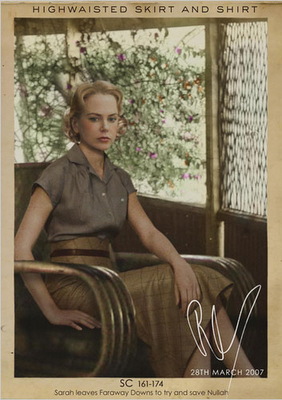
“Sportswear was being developed in the late 19th century, when women started to ride bikes and play tennis,” Ms. Martin said. “But really it was crystallized in the 1930s, when women were divested of their cumbersome undergarments and started to wear simple, beautiful clothes that were ostensibly based on men’s tailoring.” The clean lines of this traveling ensemble owe a debt to the practical, sporty designs of Chanel, Hermès and Claire McCardell. “There is a lovely synthesis of practicality, comfort and style,” Ms. Martin said. “They reveled in the age of speed and automation and the movement of the body.”
“The T-shirt he is wearing is, in fact, a shearer’s shirt, a traditional shirt that has been in that style since the late 19th century,” Ms. Martin said of Mr. Jackman’s cattle driver. “These are very traditional, classic Australian clothes, as is the plaited belt. Most of the stockmen made their own leather goods around the campfire.” The second, so-called hobble belt is used to tie together the legs of horses to keep them from wandering off. “The pants are the equivalent of Australian jeans. They are made from moleskin, and weirdly, in Australia, we wear it with the furry side in.”
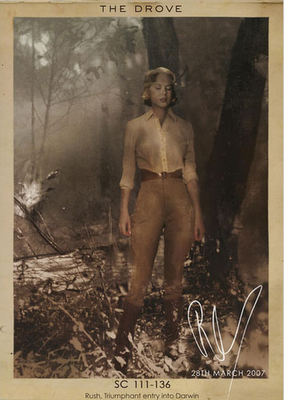
“One of the references that Baz directed me to was all those great actresses and sporty women of the 1930s, whether it’s Katharine Hepburn or Carole Lombard or the photographer Lee Miller,” Ms. Martin said. To show that Lady Ashley is similarly independent, Ms. Martin thought it was important for her to wear pants. On the cattle drive, Lady Ashley starts off in a pristine outfit but is soon reduced to tattered jodhpurs and a stained blouse. “Nicole is very athletic, and she did the majority of her own riding, so we really had to think about how practical it was for her to wear pants,” Ms. Martin said.
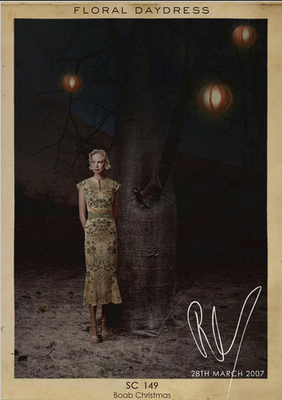
“When we went on one of the scouts to Darwin, the water was absolutely beautifully blue,” Ms. Martin said. At the time, she had on a Liberty print shirt that inspired a costume Lady Ashley wears when she and Hugh Jackman’s character are having drinks in the city. “Baz wanted those quintessential 1930s colors at sunset — a fat yellowy pink with that very ’30s green — to highlight this quite romantic and poignant scene.” This dress combines an Asian silhouette with a pheasant pattern printed on linen. “There were some lovely cigarette advertisements from the time, where you see the traditional cheongsam being Westernized,” Ms. Martin said. “All those influences came together to make that dress.”
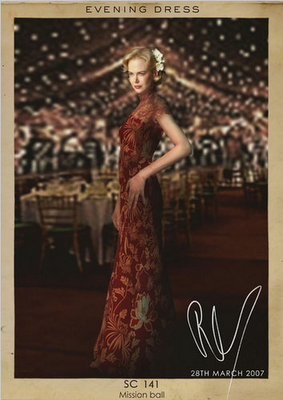
“Baz was very interested in the ethnic mix in Darwin, because Darwin is closer to Asia than it is to Sydney,” Ms. Martin said. “He started talking in a very literal and logical way: If you lost all your clothes on the drove and you had to get something made in 24 hours in Darwin, where would you go?” There were Chinese tailors working there, so she imagined a confluence of a cheongsam with a fashionable chrysanthemum print on organza.
“Sportswear was being developed in the late 19th century, when women started to ride bikes and play tennis,” Ms. Martin said. “But really it was crystallized in the 1930s, when women were divested of their cumbersome undergarments and started to wear simple, beautiful clothes that were ostensibly based on men’s tailoring.” The clean lines of this traveling ensemble owe a debt to the practical, sporty designs of Chanel, Hermès and Claire McCardell. “There is a lovely synthesis of practicality, comfort and style,” Ms. Martin said. “They reveled in the age of speed and automation and the movement of the body.”
“The T-shirt he is wearing is, in fact, a shearer’s shirt, a traditional shirt that has been in that style since the late 19th century,” Ms. Martin said of Mr. Jackman’s cattle driver. “These are very traditional, classic Australian clothes, as is the plaited belt. Most of the stockmen made their own leather goods around the campfire.” The second, so-called hobble belt is used to tie together the legs of horses to keep them from wandering off. “The pants are the equivalent of Australian jeans. They are made from moleskin, and weirdly, in Australia, we wear it with the furry side in.”
“One of the references that Baz directed me to was all those great actresses and sporty women of the 1930s, whether it’s Katharine Hepburn or Carole Lombard or the photographer Lee Miller,” Ms. Martin said. To show that Lady Ashley is similarly independent, Ms. Martin thought it was important for her to wear pants. On the cattle drive, Lady Ashley starts off in a pristine outfit but is soon reduced to tattered jodhpurs and a stained blouse. “Nicole is very athletic, and she did the majority of her own riding, so we really had to think about how practical it was for her to wear pants,” Ms. Martin said.
“When we went on one of the scouts to Darwin, the water was absolutely beautifully blue,” Ms. Martin said. At the time, she had on a Liberty print shirt that inspired a costume Lady Ashley wears when she and Hugh Jackman’s character are having drinks in the city. “Baz wanted those quintessential 1930s colors at sunset — a fat yellowy pink with that very ’30s green — to highlight this quite romantic and poignant scene.” This dress combines an Asian silhouette with a pheasant pattern printed on linen. “There were some lovely cigarette advertisements from the time, where you see the traditional cheongsam being Westernized,” Ms. Martin said. “All those influences came together to make that dress.”
“Baz was very interested in the ethnic mix in Darwin, because Darwin is closer to Asia than it is to Sydney,” Ms. Martin said. “He started talking in a very literal and logical way: If you lost all your clothes on the drove and you had to get something made in 24 hours in Darwin, where would you go?” There were Chinese tailors working there, so she imagined a confluence of a cheongsam with a fashionable chrysanthemum print on organza.
Labels:
1930s,
1940s,
Australia,
Baz Luhrmann,
Catherine Martin,
New York Times,
vintage
Sunday, November 9, 2008
Baz Luhrmann's Australia
I'm obsessed with epic costume dramas which is why I know what I'll be doing this Thanksgiving-- why, going to see the new Baz Luhrmann film, Australia, of course. Here is the trailer for the movie, set in the 1930s.Here are some movie stills courtesy of AceShowBiz


This is the spread that appeared in the July 2008 issue of American Vogue. I love these costumes!


Labels:
2008,
Australia,
Baz Luhrmann,
Hugh Jackman,
movie,
Nicole Kidman,
Thanksgiving
Subscribe to:
Posts (Atom)